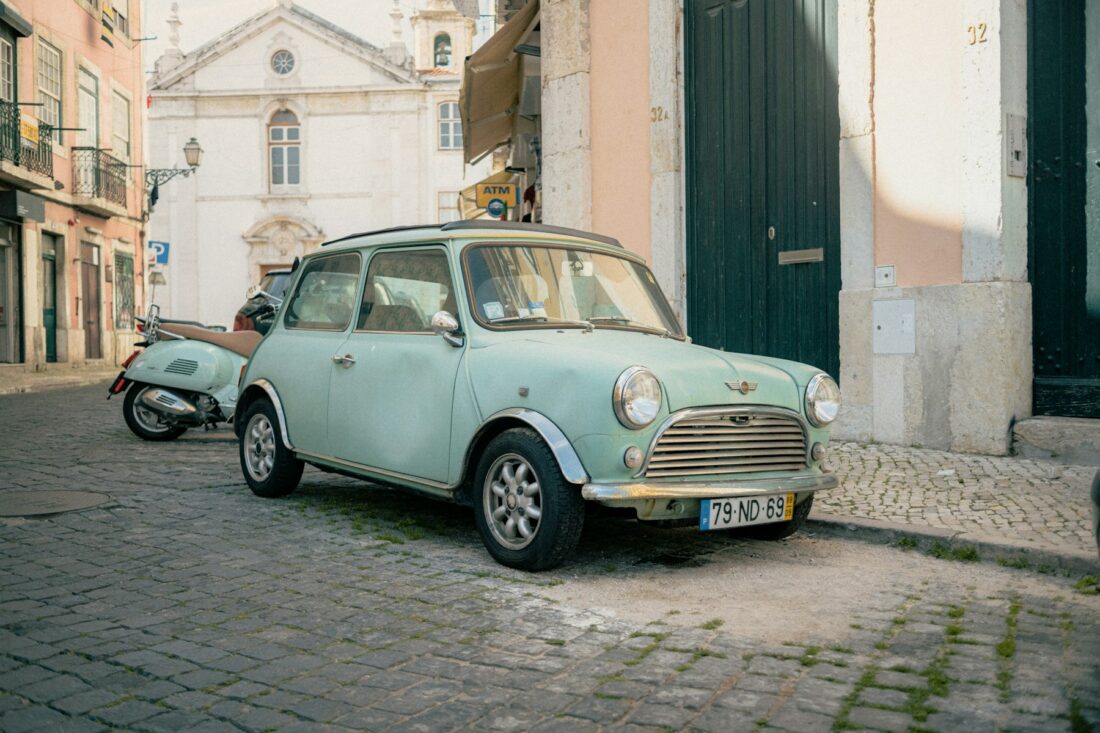
A car in Portugal costs more than its price tag. There’s a one-off tax when it’s first registered here, the annual road tax, insurance, fuel and upkeep. And before any of that comes the bigger question: buy a car here, or bring or import one from elsewhere in Europe?
Below is what each part costs, with real numbers from our own imports where we have them, and when importing a car beats buying one here.
Buying a car in Portugal
Every car pays the vehicle import tax (ISV) once, the first time it’s registered in Portugal. Buy a new car here and that tax is already in the price.
To get a feel for prices, start on olx.pt. It’s a large marketplace where many people sell second-hand cars, so it quickly shows what the car you have in mind goes for. Once you know what a fair price looks like, check dealers and smaller second-hand car companies too.
Whether you buy or import, you’ll need a Portuguese tax number (NIF).
Bring or import your car instead?
Whether that’s cheaper depends on two things: whether you’re moving here, and how much ISV your car would pay.
Moving to Portugal: tax-free import
If the car has been yours, in your own name, for at least 6 months before you officially move away from your previous country, it can come in without ISV. From that date you have 12 months to start. There are a few more rules; you’ll find all the conditions on our tax-free page.
Tax-free isn’t always the cheapest choice, though. Our fee is €750 for a tax-free import and €450 for an import with taxes, so the ISV on your car decides it. Under about €300, an import with taxes costs less, and it’s faster too. Between €300 and €400 it’s close. Over €400, tax-free usually saves you money.
Already living here: import with taxes
An import with taxes of a car from the EU comes to about €730 to €745 with all fees, plus the ISV for your car. That covers our fixed fee of €450, the vehicle registration with IMT with priority (€90), the power of attorney (€22), the inspection (about €90), the plates (€20 to €35) and the vehicle registration card (€55). Our prices page shows each part and when you pay it.
The ISV doesn’t depend on what you paid for the car. Customs works it out from its CO2, engine size, fuel and age, and a used car from another EU country gets a discount for every year since it was first registered. How the ISV is worked out. Three real cars we imported:
| Car | ISV | Total with today’s fees |
|---|---|---|
| Skoda Rapid Spaceback 1.0, from the Netherlands | About €130 | About €860 to €875 |
| Audi A3 1.9 diesel from 2005, from Belgium | Just over €2,000 | Just over €2,730 |
| Toyota RAV4 from 2018, from Germany | Just over €3,000 | Just over €3,730 |
The ISV is what each car paid at the time. Yours depends on your car’s own figures, and your personal quote shows the amount before you decide.
When importing tends to pay off
Our rule of thumb: buy a small car or a work vehicle elsewhere in Europe, and look for a good deal in Portugal if you want a large car.
Small engines pay little ISV. A 1.0 litre Nissan Pixo paid €100. Work vans pay much less than a car of the same size, as long as the seats and the cargo space are separated. Electric cars pay no ISV at all.
Big engines pay a lot, which is why a large car bought here can be the better deal. Do the sums for your own car, though. The RAV4 above paid just over €3,000 in ISV and the total was still attractive, because RAV4s cost more in Portugal.
Buying in the Netherlands? A newer Dutch car can get part of its Dutch vehicle tax (BPM) back when it leaves the country. The Skoda in the table paid about €130 in ISV, and the owner got nearly €800 in BPM back, which paid for most of the import. Always worth checking.
From outside the EU, import duty and VAT come on top of the ISV: on a €30,000 car that’s about €10,000. In case 46 we advised buying the same car in the EU instead.
Rather not arrange the purchase abroad yourself? With a Turn-key import we also find, buy and transport the car. It’s on request.
The annual road tax (IUC)
Once your car has Portuguese plates, it pays the annual road tax (IUC) every year. There are two regimes. Cars first registered in the EU before July 2007 pay the old rates, which are low. Cars from July 2007 onwards pay a lot more. A small car pays about €30 to €40 a year under the old regime, and around €150 under the new one.
So an older car is cheap to keep on the road, but that doesn’t make it cheap to import. The 2005 Audi A3 above pays only €46 a year, against €268 for a newer car with similar specs. Even with the full discount for its age, though, its 1.9 litre engine kept the ISV at just over €2,000. The low IUC earns some of that back over the years.
Electric cars and cars from before 1981 pay no IUC. You can work out the amount for your car with this IUC calculator.
Insurance
For our own small car we pay between €20 and €30 a month. What you pay depends on the car and on you as a driver, so compare quotes from a few insurers.
During an import you can keep driving on your old plates as long as your insurer still covers you. If it doesn’t, we may be able to arrange temporary import insurance. Once the car has its Portuguese plates, you take out regular Portuguese insurance. More in our article on car insurance for imported vehicles.
Fuel
Fuel prices change too often to quote here. The Preço dos Combustíveis site from DGEG, the Portuguese energy authority, compares current prices at the stations near you. Some supermarkets also give fuel discounts with their loyalty card, such as the Pingo Doce card.
Choosing a fuel for a car you’ll import? Look at the ISV as well as the price at the pump. Diesel isn’t automatically the cheaper choice: an older diesel without a particle filter can pay €500 on top. A plug-in hybrid from 2021 or later pays a quarter of the normal ISV when its CO2 is under 50 g/km and it drives at least 50 km on electricity. A fully electric car pays no ISV and no IUC.
Maintenance and parts
A small local garage is usually cheaper than a brand dealer. Just make sure the work is up to your standard: ask around for recommendations and try a few. We struck gold at the third garage we tried, and we’re happy with their prices, their service and the quality of their work.
Watch the parts. Many small garages order the cheapest parts by default, so ask for good quality, or order the parts yourself. They’re often cheaper in the Netherlands or Germany: order them online and have your local garage fit them. We know people who saved hundreds of euros in a year that way.
You don’t have to have your car serviced for its periodic inspection, but doing it just before means small problems are fixed before the inspector finds them, and before they become expensive ones.
Thinking of bringing your car, or buying one elsewhere in Europe? Our free estimate shows the average costs for your import type in 2 minutes. Your personal quote, within 1 working day, works out the ISV for your car and tells you whether tax-free or with taxes costs less. See our prices page to get started.