


![This case was definitely one of the more complicated ones, but also a great example of what’s possible with persistence and the right support. The customer contacted us about a 2008 Volkswagen Caddy that was already in Portugal. They had bought it specifically for import, but as we dug into the details, several challenges became […]](https://carimportportugal.com/wp-content/uploads/sites/100/caddy-1.jpg)
This case was definitely one of the more complicated ones, but also a great example of what’s possible with persistence and the right support.
The customer contacted us about a 2008 Volkswagen Caddy that was already in Portugal. They had bought it specifically for import, but as we dug into the details, several challenges became clear.
A Few Issues to Tackle
When importing a commercial van, especially one registered as a work vehicle, the van needs to be in its original condition. In this case, we ran into several problems:
- The divider (backboard) between the front seats and the cargo area was missing
- The van did not have European Type Approval
- The van was covered in large stickers
Each of these needed to be resolved before the vehicle could pass inspection.
The Divider
To comply with Portuguese requirements, the divider had to be reinstalled.
The customer couldn’t find one in Portugal, but eventually managed to track one down second-hand in the Netherlands. Incredibly, they even flew it back with them on a plane during a visit!
This level of dedication was impressive, but naturally, it also delayed the process by several months.
European Type Approval
While European Type Approval has been mandatory for cars since the late 1990s, it only became a requirement for work vans much later.
Unfortunately, this 2008 Caddy did not have Type Approval, meaning we had to go through a special approval process with IMT, which made the import more complex, slower, and more expensive.
The customer initially tried to reduce costs by getting a data sheet from a third-party Volkswagen representative, but it turned out to be the wrong document. After weeks of delay, they asked us to step in and obtain the correct paperwork, which added another 1–2 months to the process.
Surprise: Huge Stickers
Just when we thought everything was resolved… the stickers became an issue.
The van was completely wrapped in large vinyl decals. While stickers themselves aren’t a problem, they cannot cover the entire vehicle.
We consulted with several inspectors, and the answer was: “It depends.”
Some inspectors are more flexible, while others will require certain stickers to be removed. In this case, we had to remove some of them to move forward with approval.
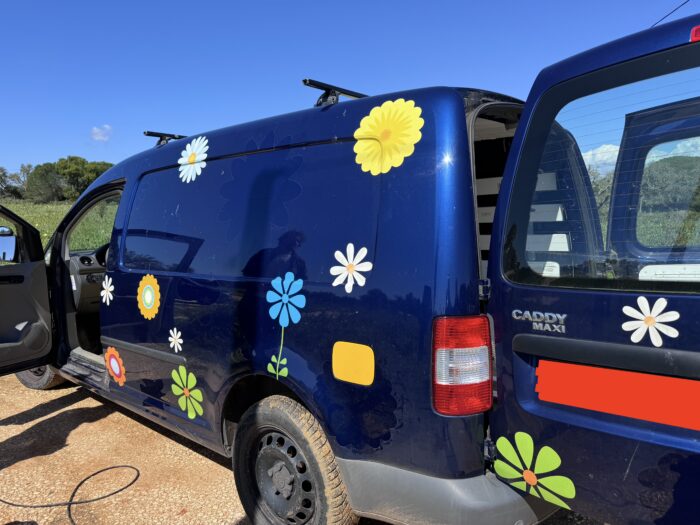
Tip: If your car has stickers or decals, show them to the inspector in advance to check if they’ll be accepted.
Inspection and Customs
Once all the pieces were finally in place, the divider, the proper paperwork, and the sticker issue resolved, the van passed inspection and the customs application was submitted without issues. The car was approved relatively quickly from that point onward.
Key Takeaways
- Original condition matters. If it’s a work van, the divider must be there. Any missing features (like seats or factory components) need to be replaced before inspection.
- A COC or European Type Approval is crucial for vans. Without it, the process becomes longer and more expensive.
- Stickers are allowed, but only to a certain extent. Large wraps may need to be partially removed. Always check with the inspector before inspection day.